

Paychex Alternative: What Are the Best Alternatives to Paychex?
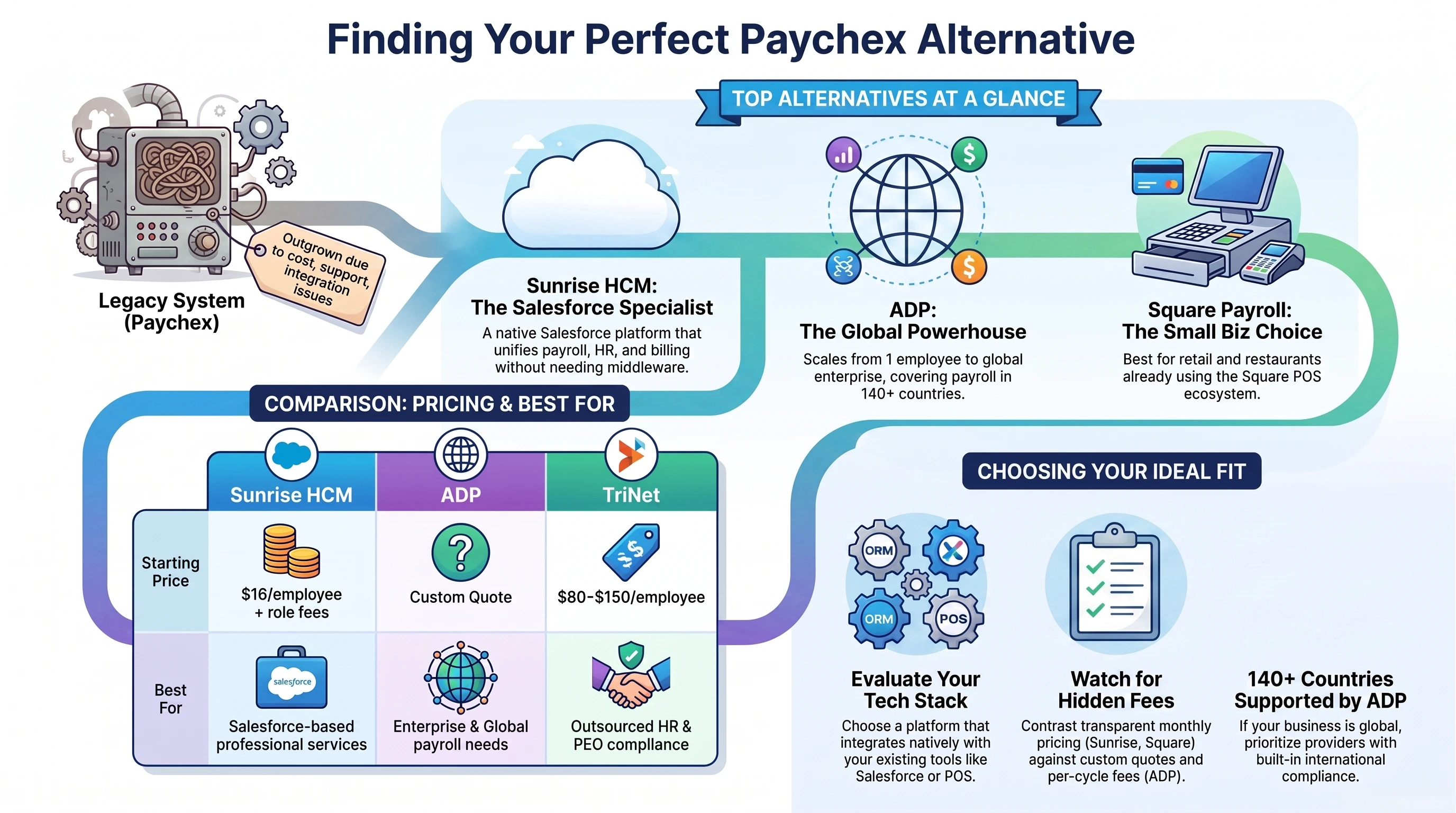
Most businesses searching for a Paychex alternative are dealing with one of a few specific problems. The pricing has crept up with each added feature tier. The dedicated rep who knew the account moved on, and service quality dropped until a new relationship formed. Or the platform is doing payroll fine but won't connect to anything else without middleware, and the monthly reconciliation is becoming its own part-time job. This guide covers the five strongest alternatives to Paychex on the market today: what each one costs, where it fits, and where it falls short.
Side-by-Side Comparison of the Best Paychex Alternatives
| Sunrise HCM | ADP | TriNet | Workday | Square Payroll | |
|---|---|---|---|---|---|
| Best For | Professional services firms on Salesforce | Enterprise and global payroll | Outsourced HR via PEO | Large enterprises needing finance, IT, and HRIS in one system | Small businesses in the Square ecosystem |
| Starting Price | $16/employee + role-based fees; no per-payroll fees | Custom quote; ~$79–$115/pay cycle for small teams | ~$80–$150/employee/month (PEO model) | $150K+ annually; implementation fee roughly equal to first-year cost | $35/mo base + $6/employee paid |
| Payroll Coverage | U.S. only; no per-payroll processing fees | U.S. + 140+ countries with local compliance | U.S. only via PEO structure | Global; continuous payroll processing | U.S. only |
| HR Features | Unified payroll, HR, time, billing, and expense | Recruiting, benefits, LMS, workforce analytics | Full HR outsourcing; enterprise benefits access | ERP, HRIS, workforce planning, deep analytics | Basic employee self-service; payroll-focused |
| Salesforce Integration | Native Salesforce platform; no middleware needed | Via third-party middleware | API only; limited native integration | Via API or third-party connector | None |
| Support Model | Dedicated U.S.-based relationship manager (included) | 24/7 phone and online; quality varies by plan | General support queue; dedicated rep varies by plan | Enterprise support model; implementation partner required | Online and phone; inconsistent during peak periods |
Payroll, HR, and billing on one Salesforce-native platform
Sunrise HCM brings it all together. No integrations, no workarounds.
What Are the Best Alternatives to Paychex?
Here is an honest look at where each platform fits and where it does not.
Sunrise HCM: Best Salesforce-Native Payroll and HRIS Tool
Sunrise HCM is a Salesforce payroll software platform built natively on Salesforce. It does not require middleware to connect payroll, HR, and billing data to Salesforce, which makes it the most operationally clean option on this list for professional services firms. Payroll, Salesforce time and expense, Salesforce billing software, and Salesforce HR software all exist in one system.
Pricing is published: $16 per employee per month, $48 per functional manager, $58 per HR manager, and a $58 base fee. That covers payroll, HR, time, billing, and expense management with no per-payroll processing fees and no add-ons required for standard functionality. A U.S.-based relationship manager is included at no extra cost. The platform is SOC 2 Type II certified.
Implementation takes eight to twelve weeks using a sprint methodology. Parallel payroll runs happen before go-live, so you're not making a blind leap on cutover day.
Sunrise HCM is U.S.-only and built around the Salesforce ecosystem. If you need global payroll or have no presence on Salesforce, it is not the right fit.
Pros
- Salesforce-native platform; payroll, HR, time, billing, and expense in one system with no middleware
- Transparent published pricing with no per-payroll processing fees
- Dedicated U.S.-based relationship manager included at no additional cost
- SOC 2 Type II certified
- Sprint-based implementation with parallel payroll runs before go-live
- Strong fit for professional services firms where billing and payroll intersect
Cons
- U.S. payroll only; no global payroll capability
- 8–12 week implementation timeline is longer than most alternatives on this list
- Requires an existing Salesforce environment; not a standalone payroll tool
- Not suited for businesses without project billing or client-facing workflows
Transparent pricing. Powerful results.
See why teams are switching to the only Salesforce-native payroll solution.
ADP: Best Enterprise Solution
ADP processes payroll across 140-plus countries and serves businesses from 1 employee (ADP RUN) to global enterprise (ADP Workforce Now). The platform's breadth is genuinely hard to match: full-service global payroll, around 500 marketplace integrations, ZipRecruiter access on most plans, and workforce analytics tools that go well beyond what Paychex offers. For U.S. businesses that need global payroll capability, ADP is the most proven option at scale.
The tradeoffs are well documented. Pricing is not published anywhere; you need a sales call for any real number. The per-cycle fee structure means your monthly bill can increase simply by running payroll more frequently, independent of headcount changes. Salesforce users need third-party middleware to connect. For a direct comparison of the two legacy platforms, the ADP vs Paychex breakdown covers where they differ across support, pricing, and HR features.
Pros
- Global payroll across 140+ countries with local compliance built in
- Around 500 marketplace integrations covering most major business software
- Scales from small business (ADP RUN) to enterprise (Workforce Now) without switching platforms
- ZipRecruiter access and background checks included on most plans
- Advanced workforce analytics available on higher-tier plans
Cons
- No published pricing; requires a sales call for any quote
- Per-cycle fee model increases costs with pay frequency, not just headcount
- Implementation takes 4–8 weeks; complex for smaller teams to manage
- Salesforce integration requires third-party middleware
- Support quality inconsistent on lower-tier plans
TriNet: Best For Outsourced HR
TriNet operates as a Professional Employer Organization. It becomes the employer of record for your team, absorbs compliance risk, handles payroll tax filings, and gives employees access to enterprise-level health, dental, and retirement benefits at group rates that most small businesses cannot negotiate independently. If the goal is getting HR largely off your plate, that model delivers real value.
The cost reflects it. TriNet typically runs $80 to $150 per employee per month depending on company size, industry, and services selected. Pricing is custom and not published. The PEO structure also means less day-to-day control over HR decisions. If you want a payroll software tool and plan to keep HR in-house, TriNet is overbuilt for that use case. For how TriNet and Paychex compare on service model and compliance support, see TriNet vs Paychex.
Pros
- Full PEO model absorbs employer liability and compliance risk
- Access to enterprise-grade health, dental, and 401(k) benefits at group rates
- Payroll processing, tax filing, and HR administration handled in one service
- Clean self-service interface for employees managing pay stubs and time off
Cons
- $80–$150 per employee per month; significantly more expensive than software-only alternatives
- No published pricing; custom quote required for any estimate
- PEO structure limits how much control your team retains over HR decisions
- Support inconsistency; dedicated rep not guaranteed on all plan tiers
- Not suitable for companies that want to run HR in-house
Tired of juggling multiple HR tools?
Sunrise HCM replaces the patchwork with one powerful platform built on Salesforce.
Workday: Best For Finance, IT, and HRIS in One System
Workday combines HRIS, payroll, financial management, and workforce planning in a single enterprise platform. Its continuous payroll function processes changes in real time rather than in batch cycles, and it handles multi-country payroll with local compliance frameworks built in. The workforce analytics and planning tools are among the most sophisticated available for large organizations.
The price point matches the enterprise positioning. Companies with fewer than 500 employees typically pay $150,000 to $300,000 or more annually, with implementation costs that roughly equal the first year's software fee. An implementation partner is required. For most companies looking for a Paychex alternative, Workday is overkill on budget and complexity. For organizations where finance, IT, and HRIS need to operate as one connected system at scale, it is genuinely hard to match. See Paychex vs Workday for a side-by-side on where the two platforms diverge for mid-market buyers.
Pros
- Unified platform for finance (ERP), HRIS, payroll, and workforce planning
- Continuous payroll processing with real-time tax updates across all U.S. jurisdictions
- Global payroll with local compliance for multi-country operations
- Deep analytics and workforce planning tools built for enterprise-scale decisions
- Highly configurable for large, complex organizations
Cons
- $150K+ annually for smaller organizations; implementation costs roughly equal annual fees
- Steep learning curve; extensive training and an implementation partner are required
- Built for large enterprises; oversized and cost-prohibitive for most mid-market buyers
- ATS and recruiting functionality is weaker than specialized platforms
- Not a practical Paychex alternative for most companies on a standard HR software budget
Square Payroll: Best For Small Businesses
Square Payroll is designed for businesses already running Square for point of sale. Timecard data from the Square POS or the Square Team App imports directly into payroll, which eliminates the manual entry that causes errors in most small hourly operations. Pricing is transparent: $35 per month base plus $6 per employee paid. Contractor-only payroll runs at $6 per person paid with no monthly base fee.
The platform works cleanly within its lane. For restaurants, retail shops, and service businesses in the Square ecosystem, it is the most operationally frictionless payroll option on this list. It does not scale into mid-market HR. There are no advanced analytics, no HR modules to speak of, and no Salesforce integration. At around 50 employees, most businesses start outgrowing it. For a direct comparison on where Square Payroll and Paychex diverge for small businesses, see Paychex vs Square Payroll.
Pros
- Simple transparent pricing: $35/month base plus $6 per employee paid
- POS and timecard data sync automatically from the Square ecosystem
- Contractor-only payroll available at $6 per person paid with no monthly base fee
- Automated federal and state tax filing across all 50 states
- Mobile-friendly employee self-service for pay stubs, W-2s, and PTO balances
Cons
- Very limited HR features; payroll-focused tool with no advanced HR modules
- Does not scale comfortably beyond roughly 50 employees
- No Salesforce integration
- Customer support can be slow to respond during peak payroll periods
- Limited customization; cannot define paid holidays or mass-update wage rates
See how it all works together
Get a personalized walkthrough of Sunrise HCM. No pressure, no commitment.
How to Choose the Right Paychex Alternative For Your Business
The right choice depends on three things: who your employees are, what systems your business already runs, and how much of HR you want to manage internally.
If your firm runs on Salesforce and needs payroll and project billing to connect without a middleware layer, Sunrise HCM is the strongest option on this list for that profile. If you need global payroll or plan to scale to enterprise, ADP handles that scope better than any other platform here. If your goal is getting HR off your plate entirely, TriNet's PEO model justifies the premium by absorbing compliance risk and unlocking enterprise-grade benefits your team likely couldn't access independently.
Workday is the right answer when you're a large enterprise that needs finance, IT, and HRIS to run as one system, and the budget supports the investment. Square Payroll fits one profile well: a small business already in the Square ecosystem that needs simple, affordable payroll without overbuilding the stack.
Get Started With Sunrise HCM Today and See Why Businesses Are Making the Upgrade!
If you're weighing what are the best alternatives to Paychex and your business runs on Salesforce, the conversation worth having is with Sunrise HCM. One platform covers Salesforce payroll, HR, time, billing, and expense management without the middleware layer that every other option on this list requires. Pricing is published, a dedicated support manager is included, and implementation uses parallel payroll runs before cutover so you're not guessing. Schedule a demo to see how it fits your workflow.
Frequently Asked Questions
What's the problem with Paychex?
The most common frustrations center on three areas. Pricing is not fully transparent, and costs escalate with each feature tier and add-on. The dedicated rep model is a genuine strength until that rep turns over, at which point service quality often drops until a new relationship is established. And Paychex has no global payroll capability at all. The integration ecosystem is narrower than most mid-market competitors, which becomes friction for businesses running more than a standard accounting stack. For a U.S. company under 100 employees running straightforward payroll, the platform performs well. The problems appear when you start needing more from it.
What is the best alternative to Paychex for a small-to-mid-sized company?
It depends on what is driving the switch. For companies on Salesforce that need payroll and billing in one system, Sunrise HCM is the strongest mid-market Paychex alternative for that profile. For businesses that need stronger HR tools and global payroll capability, ADP RUN handles the mid-market well. For very small businesses already using Square POS, Square Payroll covers the basics without overbuilding. For a direct comparison of the two legacy platforms most mid-market buyers consider, the ADP vs Paychex breakdown is a useful starting point.
Which Paychex competitor offers the best value for the money?
Value depends on what you are measuring. Sunrise HCM offers the most pricing transparency: role-based rates are published, there are no per-payroll fees, and the platform includes payroll, HR, time, billing, and expense management without add-ons. Square Payroll is the most affordable on a per-seat basis for very small teams. ADP offers the broadest feature set but requires a sales call before you see any real number. TriNet and Workday carry the highest price points, though both offer services that justify the cost for the right buyer.
How do I vet a Paychex alternative's customer service?
Three things are worth confirming before you commit. First, ask whether you will have a dedicated account manager or get routed to a general support queue. Second, check response time data in G2 and Capterra reviews from businesses your size. Third, ask specifically what happens if payroll runs on a Friday and something is wrong. That question reveals more about the real support model than any sales presentation will. Sunrise HCM includes a U.S.-based relationship manager at no extra cost. ADP support quality varies by plan tier. TriNet and Square Payroll both have mixed reviews on responsiveness.

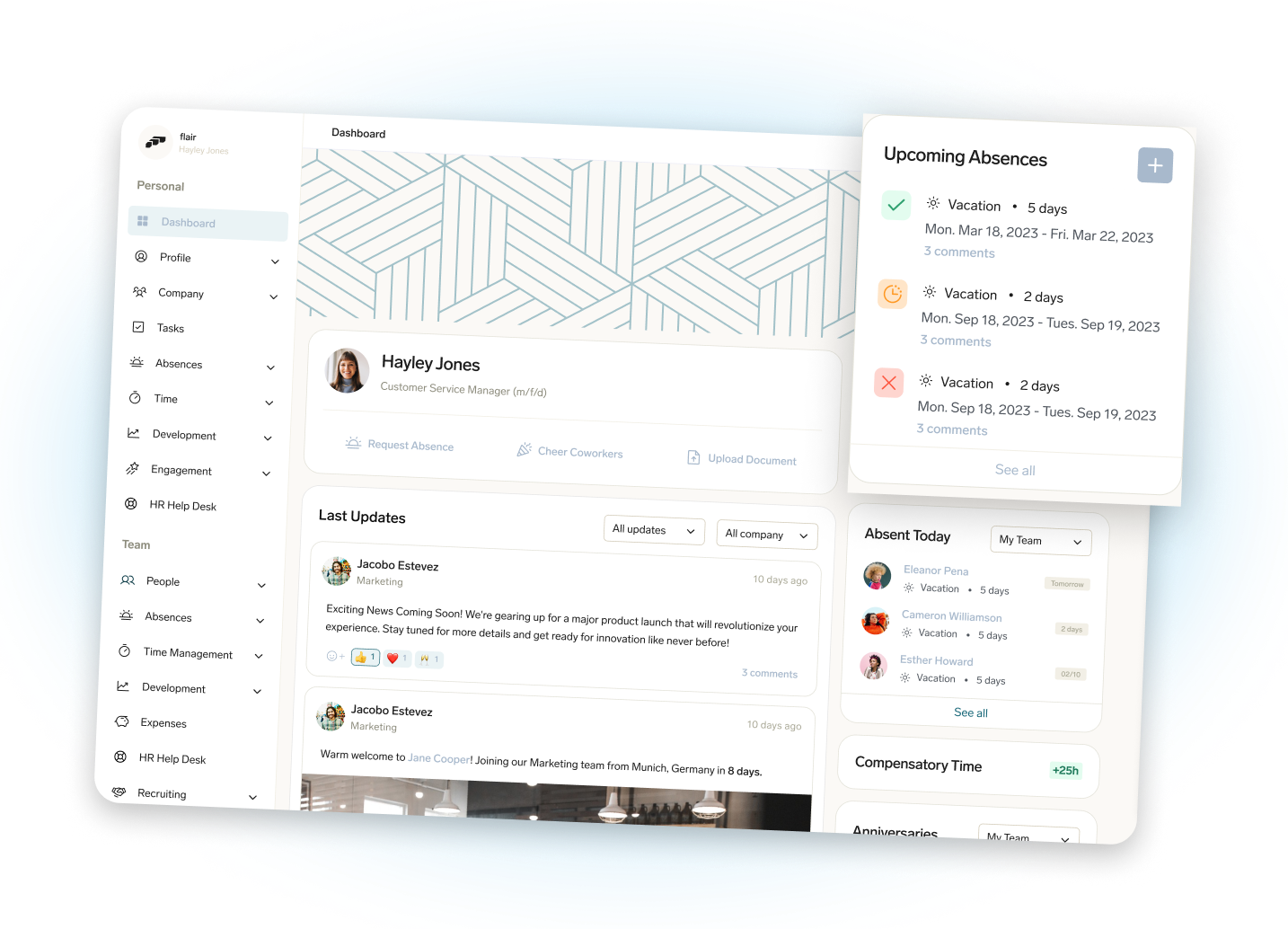


Ready to eliminate payroll fees, and simplify HR processes?
Discover how Sunrise HCM helps you automate payroll, HR, and billing with one secure and powerful Salesforce-native platform.

