black arrow left
Back to resources

Gusto vs ADP: HR and Payroll Software Comparison
January 9, 2026

Choosing between Gusto and ADP feels overwhelming when you're staring at feature lists and pricing tiers that seem designed to confuse rather than clarify. We've been there. After helping hundreds of companies navigate this exact decision, we've learned that most businesses get caught up comparing features when they should be asking a different question entirely: "Which platform will actually make my life easier?"

Gusto attracts growing companies with its promise of transparent pricing and sleek interfaces. ADP wins over organizations that need rock-solid compliance support and don't mind paying for white-glove service. The adp vs gusto decision usually comes down to complexity versus simplicity. But here's what most comparison articles won't tell you: there's a third path that combines the best of both approaches.

Sunrise HCM delivers transparent pricing like Gusto with enterprise-grade capabilities like ADP - all built natively on Salesforce. While most companies limit themselves to comparing traditional payroll providers, the smartest businesses we work with have discovered something interesting: integrated solutions eliminate the costly inefficiencies that come from juggling multiple disconnected systems.

Let's dig into what this actually means for your business.

Gusto vs ADP: Key Takeaways

Who Each Platform Serves:

  • Gusto: Small to mid-sized businesses (under 100 employees) wanting intuitive payroll with transparent pricing
  • ADP: Companies of any size needing enterprise-grade compliance, dedicated support, and complex payroll scenarios

Implementation Timeline:

  • Gusto: 1-2 weeks for standard setup with self-service onboarding
  • ADP: 2-4 weeks with professional implementation support and dedicated project management

Total Cost Considerations:

  • Gusto: Predictable costs from $55-135/month base + $6-16.50 per employee with no hidden fees
  • ADP: Quote-based pricing starting ~$79/month + $4-6 per employee, with implementation fees of 15-30% annually

Gusto vs ADP vs Sunrise HCM (Fast Facts)

Feature Gusto ADP Run Sunrise HCM
Base Pricing $55–135/month ~$79/month (quoted) $58/month
Per Employee $6–16.50 $4–6 + add-ons $16–58 (role-based)
Implementation 1–2 weeks 2–4 weeks 2–4 weeks
Salesforce Integration Third-party required Third-party required Native built-on
Time Tracking Included (Plus/Premium) Add-on cost Included
Billing Module Not available Not available Included
Multi-state Payroll Plus plan required All plans Included
Customer Support Phone/email/chat Dedicated reps (larger clients) U.S.-based relationship manager

All About ADP

Overview

ADP Run is what happens when a company that's been processing payroll since before your parents met tries to modernize for today's small businesses. Drawing from over 75 years in the payroll game, ADP brings serious expertise to the table - the kind that comes from handling everything from union shops to multi-state nightmares that would make other providers break out in cold sweats.

Here's the thing about ADP: they built their reputation solving problems for massive enterprise clients first, then figured out how to package that expertise for smaller companies later. This shows up everywhere in their platform - you get comprehensive compliance features that can handle virtually anything you throw at them, but the trade-off is interfaces that sometimes feel like they were designed by compliance attorneys rather than UX designers.

If you're the type of business owner who values proven expertise over pretty interfaces, ADP's approach makes sense. If you want something that feels modern and intuitive right out of the box, you might find yourself frustrated.

Pricing Snapshot

ADP Run employs consultation-based pricing that varies significantly by company size, feature selection, and implementation requirements:

Service Levels:

  • Essential Payroll: Basic processing with automated tax filing
  • Enhanced Payroll: Multi-state capabilities and time tracking modules
  • Complete Payroll & HR: Full HRIS with benefits administration
  • HR Pro: Dedicated consultation services and compliance management

Industry research indicates typical investments begin around $79 monthly plus $4-6 per employee, though final costs often increase substantially through required add-ons. Implementation fees commonly range 15-30% of annual subscription costs, with some organizations reporting total ownership costs 50-100% higher than initial estimates.

Additional Cost Factors:

  • Professional services for setup and customization
  • Add-on modules for benefits, time tracking, and HR support
  • Integration development for enterprise systems
  • Ongoing consulting fees for compliance management

Pricing verified December, subject to change. Contact ADP directly for current quotes.

Who it's Best For

ADP Run works particularly well for organizations requiring:

Complex Compliance Scenarios: Companies operating across multiple states, handling wage garnishments, or managing union reporting requirements benefit from ADP's extensive regulatory expertise and dedicated compliance monitoring.

Professional Service Relationships: Businesses preferring dedicated account management and professional implementation support over self-service platforms find value in ADP's consultation-driven approach.

Enterprise Integration Needs: Organizations requiring sophisticated connections with ERP systems, custom reporting, or complex data flows appreciate ADP's professional services capabilities and established partner network.

Established HR Departments: Companies with experienced HR professionals who can leverage ADP's comprehensive feature set without requiring extensive training or simplified interfaces.

What's Great About Gusto?

Overview

Gusto started with a simple but radical idea: payroll shouldn't require a degree in accounting or a team of specialists to figure out. While ADP was perfecting enterprise-grade complexity, Gusto was asking "Why can't running payroll be as easy as ordering lunch online?"

The answer, it turns out, is that it absolutely can be - if you're willing to prioritize simplicity over comprehensive features. Gusto serves over 400,000 organizations by focusing on what most small businesses actually need: straightforward payroll processing, benefits that don't require a PhD to understand, and HR tools that regular humans can actually use.

This philosophy has resonated particularly well with the growing businesses we see most often - companies that have outgrown spreadsheets and QuickBooks but aren't ready for enterprise-level complexity. If you're the type of business owner who wants to set up payroll during lunch break rather than scheduling a week of training sessions, Gusto's approach will feel refreshing.

Pricing Snapshot

Gusto structures its offerings transparently across four subscription levels:

Plan Structure:

  • Simple Payroll ($49/month + $6/employee): Core payroll processing with automated tax filing
  • Plus ($89/month + $12/employee): Adds benefits administration and time tracking
  • Premium ($149/month + $16.50/employee): Includes HR tools and advanced reporting
  • Contractor Only ($35/month + $6/contractor): Specialized for 1099 management

Independent pricing research confirms these published rates remain consistent across business sizes, with no hidden fees or surprise charges. Customer studies indicate users typically reduce payroll processing time by 4+ hours monthly after switching to Gusto, making it particularly attractive for resource-constrained growing businesses.

Included Features Across Plans:

  • Automatic payroll tax calculations and filings in all 50 states
  • Direct deposit processing with next-day funding
  • Employee self-service portal for pay stubs and personal information
  • Mobile app access for both employees and administrators
  • Basic reporting and analytics for payroll insights

Pricing verified December, subject to change. Visit Gusto's website for current rates.

Who it's Best For

Gusto particularly serves businesses that prioritize:

Operational Simplicity: Companies wanting payroll processing without complex configuration or specialized HR knowledge benefit from Gusto's intuitive design and self-service capabilities.

Transparent Pricing: Organizations preferring predictable monthly costs over consultation-based pricing models appreciate Gusto's published rates and fee structure transparency.

Employee Experience: Businesses emphasizing modern user interfaces and employee self-service tools find value in Gusto's consumer-grade design approach and mobile accessibility.

Growing Teams: Companies scaling from 10 to 100+ employees appreciate Gusto's ability to add functionality without significant complexity increases or major system changes.

Gusto vs ADP: Complete Platform Analysis

This comprehensive adp vs gusto hr and payroll software comparison examines real-world usage. ### At a Glance

Here's what really matters: Gusto built their platform around the idea that payroll should be simple and transparent, even if that means fewer integration options. The adp vs gusto comparison reveals fundamentally different philosophies. ADP took the opposite approach - they'll integrate with anything that has an API, even if it means more complexity upfront.

Gusto charges you a predictable monthly fee per employee and includes everything they think you need. No surprise bills, no "gotcha" fees, no sales calls about premium modules. ADP prefers the consultation approach - they'll customize a solution for your specific needs, but you'll pay accordingly and implementation can feel like a bigger project than you initially signed up for.

Neither platform was designed with professional services firms in mind. If you're billing time to clients, both will require you to cobble together third-party tools for time tracking and project billing. This is where a lot of businesses discover they've solved their payroll problem but created new headaches around data entry and reconciliation.

Gusto vs ADP: Payroll Processing and Tax Compliance

Both platforms handle comprehensive payroll processing for U.S.-based employers with automated tax compliance across all jurisdictions. The gusto vs adp payroll debate often centers on implementation complexity. They manage federal 941/940 filings, state unemployment insurance (SUI), local tax compliance, multi-state nexus and reciprocity handling, and year-end W-2 and 1095-C reporting.

Gusto's Approach: Emphasizes simplicity with transparent payroll processes visible to both administrators and employees. The system guides users through payroll runs with clear explanations of deductions, taxes, and calculations. Multi-state capabilities require upgrading to Plus tier, while automated compliance updates happen seamlessly across all plans.

ADP's Approach: Leverages extensive regulatory expertise with professional compliance monitoring and dedicated support specialists. The platform handles complex scenarios including wage garnishments, union reporting, and multi-FEIN operations through comprehensive backend automation. Implementation includes professional consultation for complex compliance requirements.

Winner: ADP - Better for companies with complex compliance requirements, multiple states, or specialized regulatory needs. Gusto wins for businesses wanting transparent, straightforward payroll processing with clear employee communication.

HR Management and Employee Records

Beyond basic gusto vs adp payroll features, HR capabilities differ significantly. Gusto's HR Capabilities: Provides comprehensive employee lifecycle management through intuitive interfaces designed for non-HR professionals. Features include digital onboarding workflows, document storage with e-signatures, PTO tracking with automated accruals, and performance review tools. The platform emphasizes employee self-service with modern mobile applications for updating personal information and accessing HR resources.

ADP's HR Platform: Offers modular HRIS capabilities that scale from basic employee record keeping to comprehensive talent management. Advanced features include succession planning, learning management systems, and customizable approval workflows. The system integrates with existing enterprise applications while providing dedicated account management for ongoing HR strategy consultation.

Winner: ADP - More comprehensive HR functionality with enterprise-grade features and professional services support. Gusto provides better user experience for companies needing straightforward HR management without complex workflows.

Time Tracking and Scheduling

Gusto's Time Management: Includes time tracking in Plus and Premium plans with mobile clock-in capabilities, overtime calculations, and basic scheduling tools. The system connects directly with payroll processing while providing employees with transparency into their time records. Features work well for straightforward hourly tracking but lack advanced workforce management capabilities.

ADP's Time Solutions: Offers comprehensive time and attendance through add-on modules with biometric options, geofencing, and advanced scheduling tools. The platform supports complex scenarios including break tracking, shift differentials, and labor cost analysis. Integration with payroll happens automatically while providing detailed reporting for labor law compliance.

Winner: ADP - More sophisticated time tracking options with better integration capabilities. Gusto provides adequate functionality for basic time tracking needs with easier implementation.

Benefits Administration

Gusto's Benefits Platform: Acts as benefits broker with direct insurance carrier relationships, simplifying enrollment and ongoing administration. Employees access decision support tools that recommend plans based on individual circumstances. Health insurance administration comes at no additional cost when Gusto serves as broker, creating potential savings compared to separate vendor relationships.

ADP's Benefits Network: Connects with major insurance carriers through established partnerships while offering employee decision support tools. The platform accommodates complex benefits scenarios including multiple plan options, flexible spending accounts, and COBRA administration. Professional services include benefits strategy consultation and compliance monitoring.

Winner: Gusto - Simpler benefits administration with integrated carrier relationships and no additional broker fees. ADP provides more comprehensive benefits management for complex organizational needs.

Applicant Tracking and Performance Management

Gusto's Talent Tools: Includes basic applicant tracking with job posting, interview scheduling, and offer letter generation. Performance management features cover goal setting, review cycles, and employee surveys. The unified system means new hire information flows directly to payroll and benefits without manual data transfer.

ADP's Talent Suite: Provides comprehensive talent acquisition through marketplace integrations including background screening, skills assessments, and onboarding automation. Performance management includes goal cascading, succession planning, and advanced analytics. Professional services support include recruiting strategy and talent development consultation.

Winner: ADP - More comprehensive talent management with professional services support and advanced features. Gusto provides adequate functionality for basic hiring and performance management needs.

Integration Capabilities

Gusto's Integration Approach: Connects with over 180 business applications through APIs and marketplace partnerships. Popular integrations include QuickBooks, Xero, and various time tracking solutions. Standard data exports and basic webhook capabilities support common business workflows.

ADP's Integration Ecosystem: Features over 800 marketplace integrations covering accounting, CRM, and specialized HR applications. Open APIs enable custom development while professional services support complex integration requirements. The platform accommodates existing technology investments while providing unified data management.

Winner: ADP - Significantly more integration options with professional services support for complex scenarios. Gusto provides adequate connectivity for standard business applications.

Reporting and Analytics

Gusto's Reporting: Provides standard payroll reports plus employee analytics covering compensation trends, turnover patterns, and benefits utilization. Dashboard visualizations help identify patterns while maintaining focus on actionable insights rather than comprehensive data analysis. Export capabilities support external business intelligence tools.

ADP's Analytics Platform: Features comprehensive workforce analytics with benchmarking against industry peers and predictive insights for turnover and engagement. Advanced reporting includes custom report building with drill-down capabilities. Professional services include analytics consultation and strategy development.

Winner: ADP - More sophisticated analytics capabilities with professional consultation support. Gusto provides clear, actionable reporting for standard business needs.

User Interface and Learning Curve

Gusto's Design Philosophy: Emphasizes consumer-grade interfaces designed for ease of use across all user types. Mobile applications receive consistently high ratings for employee self-service capabilities. Implementation requires minimal training while maintaining comprehensive functionality access.

ADP's Interface Approach: Varies across modules but generally follows enterprise software standards with comprehensive functionality access. Professional implementation includes training programs and ongoing support. Learning curve reflects the platform's extensive capabilities and customization options.

Winner: Gusto - More intuitive interface design with shorter learning curves for all users. ADP provides comprehensive functionality for users willing to invest in training.

Gusto vs ADP: Pricing and Total Cost of Ownership

Gusto's Approach: What you see is what you get. They publish their pricing on their website, you can calculate your monthly cost in about 30 seconds, and there are no implementation fees or setup charges lurking in the fine print. For a 50-employee company, you're looking at somewhere between $349-974/month depending on which features you need.

The beauty of Gusto's model is predictability. Need to budget for next year? Easy calculation. Want to know what adding 10 employees will cost? Simple math. This transparency is rare in the payroll world and frankly refreshing after dealing with vendors who treat pricing like state secrets.

ADP's Reality: Getting accurate pricing from ADP feels a bit like buying a car - expect some back-and-forth, customization discussions, and implementation fees that can add 15-30% to your first year costs. For that same 50-employee company, you're probably looking at $479-879/month plus professional services fees.

The frustrating part isn't necessarily the cost - ADP often delivers good value for complex scenarios. It's the unpredictability. Budget planning becomes guesswork when you don't know what modules you'll need or how much implementation will actually cost until you're halfway through the process.

Winner: Gusto - Unless you genuinely need ADP's advanced capabilities, the pricing transparency alone makes Gusto easier to work with. ADP provides better value when you need extensive professional services and can justify the complexity.

Gusto vs ADP: What Do Customer Reviews Say?

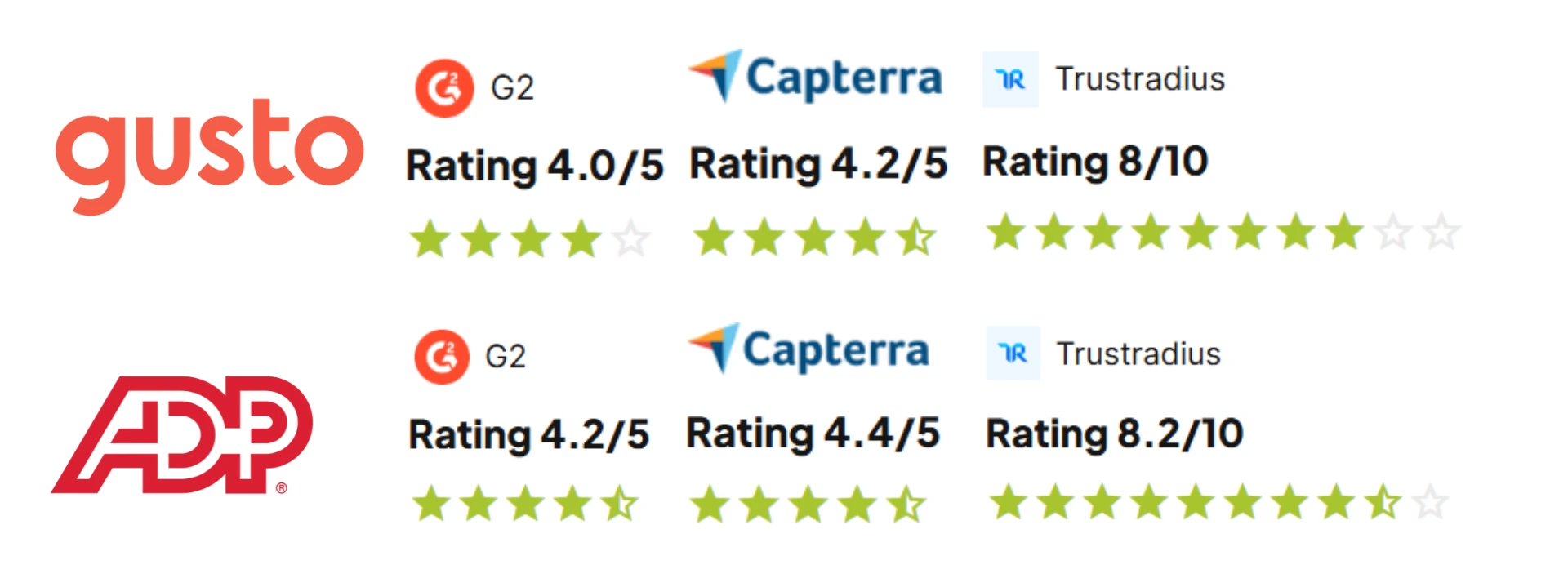
When analyzing adp vs gusto user feedback, patterns emerge quickly. ### Platform Ratings Comparison

Gusto Vs ADP Ratings.webp

Gusto Customer Feedback:

  • G2: 4/5 based on 3,200+ reviews
  • Capterra: 4.2/5 based on 3,100+ reviews
  • TrustRadius: 8/10 based on 1,200+ reviews

User Sentiment Analysis: Customers consistently praise ease of use, transparent pricing, and responsive customer support. Common criticisms include limited advanced HR features and integration options compared to enterprise platforms.

Understanding what do customer reviews say about gusto vs adp helps predict your experience. User feedback provides crucial insights for any adp vs gusto hr and payroll software comparison.

Representative feedback:

  • Positive: "Setup was incredibly straightforward, and employees love the mobile app" - Operations Manager
  • Critical: "Works well for basic needs but lacks advanced reporting capabilities" - Finance Director

ADP Customer Experience:

  • G2: 4.2/5 based on 1,465+ reviews
  • Capterra: 4.4/5 based on 1,088+ reviews
  • TrustRadius: 8.2/10 based on 800+ reviews

User Feedback Patterns: Reviews highlight comprehensive compliance support and professional services quality while noting pricing complexity and implementation challenges. Customer satisfaction correlates strongly with organization size and complexity requirements.

Representative feedback:

  • Positive: "Handles complex multi-state payroll seamlessly with excellent support" - HR Director
  • Critical: "Implementation took longer than expected with several pricing surprises" - Business Owner

Customer satisfaction scores reflect ADP's strength in comprehensive functionality against Gusto's advantage in user experience and transparency.

So what do customer reviews say about gusto vs adp overall? The verdict depends on business size and complexity needs.

Ratings and quotes from G2, Capterra, TrustRadius. Quotes shortened for clarity.

When Does Sunrise HCM Make More Sense?

Both Gusto and ADP solve payroll problems well, but here's what we've learned after working with hundreds of businesses: the biggest pain point isn't actually payroll processing - it's the constant data entry between disconnected systems.

Think about your current workflow. You probably track time in one system, process payroll in another, and handle client billing in a third. Then someone on your team spends hours each month making sure all three systems match up. Sound familiar?

This is exactly why we built Sunrise HCM differently. Instead of creating another standalone payroll system, we built everything on Salesforce so your time tracking, payroll, and billing actually talk to each other.

Built on Salesforce (But You Don't Need Salesforce)

Here's something that surprises most people: you don't need an existing Salesforce setup to use Sunrise HCM. We include the Salesforce platform infrastructure in your subscription. You're not buying anything extra from Salesforce or dealing with separate licenses.

What you get is a database that's already trusted by banks, hospitals, and government agencies. Automatic security updates. Continuous backups across multiple locations. The same architecture that supports Fortune 500 companies, without you having to manage any of the technical stuff.

Already using Salesforce? Great - we'll discount your pricing since you already have the platform infrastructure. If not, no problem - everything you need is included.

Why This Actually Matters for Your Business

Let's say you need to change an employee's hourly rate. In most setups, you'd update it in HR, then remember to update it in your time tracking system, then make sure it's correct in payroll, and finally check that it flows through to client billing correctly.

With Sunrise HCM, you change it once. The update flows automatically to time tracking, payroll, and billing. No double-entry. No wondering if everything matches. No monthly reconciliation headaches.

We've watched businesses save 10+ hours per month just on data entry elimination. That's time you can spend growing your business instead of managing administrative busywork.

Real Support From People Who Get It

Every Sunrise HCM client gets a dedicated U.S.-based relationship manager and backup contact. No premium support tiers to unlock basic human assistance. No offshore call centers where you have to explain your business model from scratch every time you call.

Our support team includes former payroll industry veterans who've dealt with everything from garnishments to multi-state compliance nightmares. When you call with a question, you're talking to someone who understands both the technology and the regulatory requirements behind your question.

Honest Pricing (Because Hidden Fees Are Annoying)

Here's our complete pricing structure:

  • $16 per employee per month
  • $48 per functional manager per month (people who approve time and expenses)
  • $58 per HR Manager per month (HR administrators and power users)
  • $58 base fee per month

That's it. Everything included: payroll processing, tax filing, W-2s, HR management, time tracking, expense management, and project billing. Zero payroll processing fees. No transaction fees. No surprise charges.

We also offer discounted pricing for nonprofits, government organizations, and educational institutions because we believe good tools should be accessible.

When Sunrise HCM Makes Sense for Your Business

  • You're tired of entering the same data multiple times
  • You need integrated project billing that actually connects to payroll
  • You want single time entry that flows to both payroll and client invoicing
  • You value predictable pricing without gotcha fees
  • You want enterprise-grade security without enterprise complexity

When You Should Stick with Gusto or ADP

  • You only need basic payroll and HR (no project billing or time tracking integration)
  • You're perfectly happy with your current time tracking and billing setup
  • You need extensive international payroll (we're US-only)
  • You prefer working with larger, established providers for HR management

Getting Started

Most implementations take 2-4 weeks. We run payroll in parallel with your current provider for 1-2 cycles to make sure everything matches your expectations before you switch over completely.

Contact us to see how payroll, HR, time tracking, and billing work together in one system. No sales pressure - just an honest conversation about whether this approach makes sense for your business.

Gusto vs ADP: Final Decision Guide

The adp vs gusto choice depends on your operational priorities. Gusto excels for growing businesses prioritizing simplicity, transparent pricing, and modern user experiences. The platform removes traditional payroll complexity while maintaining comprehensive functionality for companies scaling from startup to mid-market size. Its self-service approach works particularly well for organizations without dedicated HR resources.

ADP Run serves organizations requiring comprehensive compliance support, dedicated account relationships, and sophisticated payroll scenarios. While pricing transparency suffers and implementation demands more investment, the platform provides enterprise-level capabilities for companies needing that depth.

Neither platform offers native Salesforce integration or unified project billing - critical gaps for many professional services firms and Salesforce-centric organizations. These limitations create opportunities for more integrated solutions like Sunrise HCM, which addresses both payroll processing and business operations through a single platform.

Consider your current pain points, growth trajectory, and technical requirements when making this decision. The right choice depends less on feature checklists and more on how each platform aligns with your operational philosophy and resource constraints.

These common adp vs gusto questions help clarify the decision.

Gusto vs ADP: Frequently Asked Questions

Is Gusto related to ADP?

Nope, they're completely separate companies that just happen to compete in the same space. Gusto started in 2012 with the mission to make payroll less painful for small businesses. ADP has been around since 1949 - they've literally been processing payroll since before computers were a thing. They compete against each other pretty aggressively, but there's no business relationship between them.

How do Gusto and ADP compare to other payroll solutions like Paychex or Paycom?

Great question - the payroll space has gotten pretty crowded, and each platform has its own philosophy. When people ask what do customer reviews say about gusto vs adp versus other platforms, the answer varies by use case. QuickBooks vs Gusto shows how accounting integration differs from comprehensive HR platforms. Paychex vs ADP highlights different approaches to pricing transparency and customer support. ADP vs Paycom demonstrates unified database approaches versus modular flexibility.

The key insight from all these comparisons? Understanding your specific workflow needs matters way more than checking boxes on feature lists when you're evaluating payroll and HR solutions.

What's the difference between Gusto and ADP for project-based businesses?

Here's where things get interesting. If you're billing time to clients, both platforms will leave you hanging. Gusto focuses on employee management and benefits - great for keeping your team happy, but it won't help you track project time or generate client invoices. ADP has tons of integrations, but you'll need middleware to connect everything, and you're still looking at separate systems for time tracking and billing.

Professional services firms often need more than basic payroll - you need one place where time entry flows automatically to both payroll and client invoicing. Neither Gusto nor ADP was designed for this workflow, which is why most project-based businesses end up with a patchwork of tools that don't talk to each other.

How do mobile capabilities and employee self-service compare?

Both platforms have decent mobile apps, but they approach employee experience differently. Gusto's apps feel consumer-grade - your employees can handle benefits enrollment, request time off, and access documents without calling you for help. The HR self-service capabilities are genuinely user-friendly.

ADP's mobile experience varies by plan tier. Higher-tier plans get better functionality, but even then, it feels more like enterprise software adapted for mobile rather than built mobile-first.

Worth noting: Sunrise HCM's mobile capabilities run through Salesforce's native mobile platform. Your team gets complete access to payroll, HR, time tracking, and expense management from any device - no separate apps to download or train people on.

Which platform handles complex payroll scenarios better?

ADP wins this one hands down. They've been dealing with union reporting, wage garnishments, and multi-state nightmares for decades. If your payroll situation involves anything that might stump a typical payroll person, ADP's depth of experience shows. Their professional implementation team has probably seen whatever weird scenario you're dealing with.

Gusto handles most standard payroll situations well, but you might hit limitations if you need advanced features like complex multi-state processing.

Sunrise HCM handles complex scenarios too - shift differentials, multiple pay rates per employee, garnishments, you name it. The difference is we don't charge processing fees for complexity like most providers do.

How do pricing models actually work in practice?

Most gusto vs adp payroll cost comparisons miss hidden implementation fees. Gusto shows transparent pricing upfront: $55-135/month base plus $6-16.50 per employee depending on plan tier. All features are included without surprise charges, though upgrading for additional capabilities increases monthly costs predictably.

ADP uses consultation-based pricing that varies by company size, selected modules, and implementation requirements. Quote-based pricing starts around $79/month plus $4-6 per employee, with implementation fees typically adding 15-30% to first-year costs.

Sunrise HCM eliminates hidden fees: $16 per employee, $48 per functional manager, $58 per HR Manager, plus $58 base fee monthly. Everything included without processing fees, transaction charges, or module costs. Contact us to learn about pricing specific to your organization type.

What about data security and compliance automation?

The gusto vs adp payroll security approaches reflect their different target markets. Both platforms handle essential compliance requirements, but their security approaches differ significantly. Gusto emphasizes user-friendly interfaces with backend compliance automation. ADP leverages enterprise-grade security through their data centers and dedicated compliance teams.

Sunrise HCM inherits enterprise security from Salesforce's SOC 2 Type II compliant platform, providing bank-level security without managing infrastructure complexity. Automated compliance tracking across all 50 states ensures regulatory changes update automatically.

Can these platforms integrate with existing business software?

ADP offers over 800 marketplace integrations supporting existing technology investments, making it excellent for companies with established software ecosystems. Gusto provides standard integrations with major accounting and HR platforms but focuses more on built-in functionality than extensive third-party connections.

Integration capabilities vary significantly when businesses need real-time data flow between payroll, time tracking, and client billing systems. Middleware solutions create sync delays and potential data inconsistencies that impact both payroll accuracy and billing timeliness.

Which works better for companies planning rapid growth?

Gusto scales well for companies growing from 10 to 100+ employees with predictable feature additions and transparent pricing increases. The platform's simplicity helps growing teams avoid complexity while maintaining operational efficiency.

ADP's modular approach allows companies to add capabilities as needed, supporting growth from small business to enterprise scale. However, pricing becomes less transparent as complexity increases, and implementation requirements grow accordingly.

Sunrise HCM's Salesforce foundation provides enterprise scalability from day one, with automatic updates and zero-downtime upgrades ensuring systems grow seamlessly with business requirements.

How do implementation timelines and support quality compare?

Gusto: 1-2 weeks with self-service onboarding, supported by phone, email, and chat during business hours. Implementation focuses on simplicity and user-friendly guidance.

ADP: 2-4 weeks with professional implementation support and dedicated project management. Larger clients receive account representatives, though support quality varies by location and plan tier.

Sunrise HCM: 2-4 weeks using our proven sprint methodology, including parallel payroll testing and comprehensive training with dedicated U.S.-based relationship managers for every client at no extra cost.

Are there discounts available for nonprofits or educational institutions?

What do customer reviews say about gusto vs adp for nonprofits? Both offer limited special pricing options. Gusto and ADP occasionally offer promotional pricing for new customers and seasonal sales, but standard rates apply to most organizations. Pricing negotiations may be possible for larger implementations.

Sunrise HCM provides specific discounted pricing for nonprofits, government organizations, and educational institutions. Contact us to learn about pricing specific to your organization type.

What happens if you need to switch payroll providers?

Any thorough adp vs gusto hr and payroll software comparison should address migration considerations. Switching requires careful planning but isn't overly complex with proper preparation. Most transitions take 2-4 weeks including data migration, system configuration, and parallel testing. Key considerations include timing (ideally at year-end), gathering historical data, coordinating data exports, and running parallel payroll cycles.

Both Gusto and ADP provide migration support, while Sunrise HCM includes comprehensive transition assistance as part of our implementation process, ensuring seamless migration without disrupting employee pay cycles.

sunrise sun gray logo lower rightdemo image placeholder

Free demo

The flexible HR platform built on Salesforce
sunrise green sun lower leftsunrise sun logo lower right

Ready to eliminate payroll fees, and simplify HR processes?

Discover how Sunrise HCM helps you automate payroll, HR, and billing with one secure and powerful Salesforce-native platform.