

Gusto Alternatives: What is the Best Alternative to Gusto for an HRIS?
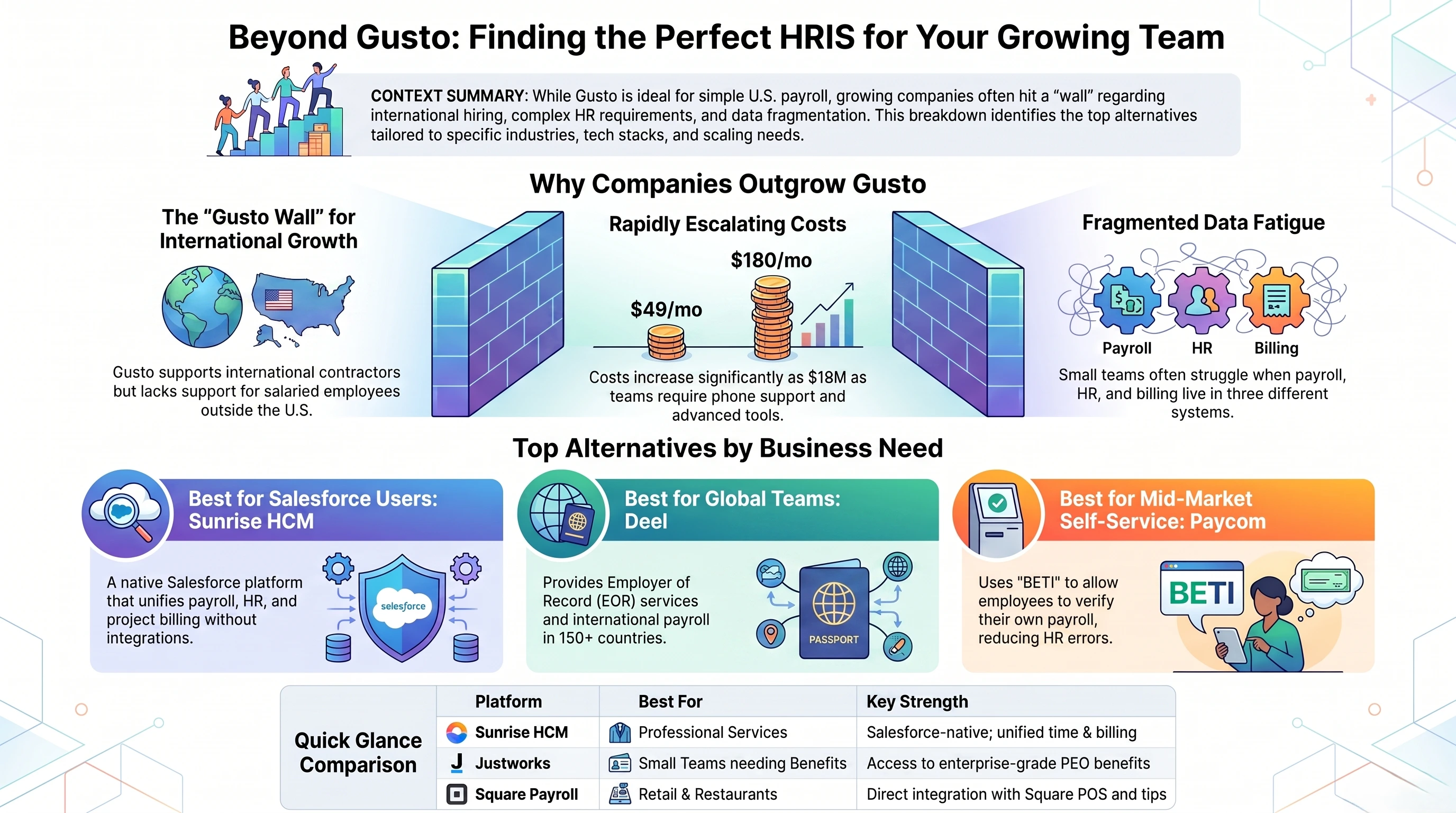
Gusto was built for small businesses that need simple U.S. payroll and not much else. For a while, that is exactly what most companies need. Then headcount grows, HR requirements deepen, or someone on the team asks why payroll data, HR records, and project billing still live in three different places. That is usually when the search for a Gusto alternative starts.
This guide covers 10 alternatives worth a real look. For each one, we break down features, pricing, and who it actually fits, so you can make the comparison without sitting through five demos first.
Quick Comparison of the Best Alternatives to Gusto
| Platform | Best For | Starting Price | Key Strength |
|---|---|---|---|
| Sunrise HCM | Professional services firms on Salesforce | $16/employee/mo | Salesforce-native; unified payroll, HR, time & billing |
| Paycom | Mid-market; employee self-service focus | Quote-based (~$22–$36/ee/mo) | BETI employee-driven payroll; deep self-service tools |
| ADP | Small business through enterprise | Quote-based | Broadest feature set; 70+ years of payroll expertise |
| QuickBooks Payroll | QuickBooks accounting users | $45/mo + $6/employee | Native QuickBooks integration; tax penalty protection |
| BambooHR | HR-first, office-based organizations | Quote-based (~$8–$25/ee/mo) | Onboarding, performance management, employee experience |
| Namely | Mid-market; culture-focused teams | Quote-based (~$9–$25/ee/mo) | Employee engagement; social recognition tools |
| Paylocity | Mid-market; distributed teams | Quote-based (~$12–$22/ee/mo) | Payroll accuracy + employee engagement features |
| Justworks | Small businesses wanting PEO benefits | From $59/employee/mo | Enterprise-grade benefits access at small business rates |
| Deel | Global teams and contractors | $49/mo (contractors) / $599/ee/mo (EOR) | International payroll and EOR in 150+ countries |
| Square Payroll | Retail, restaurant, and hourly teams | $35/mo + $6/employee | Square POS integration; tip pooling; simple hourly payroll |
Payroll, HR, and billing on one Salesforce-native platform
See how Sunrise HCM connects your entire people and revenue operation without integrations.
Why You Need a Better Gusto Alternative
Gusto earns its reputation for simplicity. The setup is fast, the interface is clean, and for a small team running straightforward U.S. payroll, it does the job. The problems show up when your needs outgrow the design.
Pricing escalates quickly. Simple is $49/mo plus $6 per employee. Plus doubles the base to $80/mo plus $12. Premium runs $180/mo plus $22. For a 50-person team, those jumps are real, and the added features don’t always justify the step-up.
HR tools are thin at entry level. The Simple plan handles payroll but leaves onboarding, PTO, and performance tracking underpowered. Most teams end up managing those in separate tools, which is exactly the data fragmentation an HRIS is supposed to fix.
International employee payroll isn’t an option. Gusto pays contractors in 120+ countries, but salaried employees outside the U.S. aren’t supported at any tier. For companies adding international headcount, that’s a hard wall.
Support depends on your plan. Phone access requires Premium. Simple and Plus users get chat and email, which slows things down when a payroll issue needs a same-day answer.
Reporting stays basic. Gusto’s analytics don’t give HR teams the workforce visibility growing companies need for headcount planning or labor cost analysis.
What is the Best Alternative to Gusto for an HRIS?
The answer depends on your company size, tech stack, and which Gusto limitation is costing you the most. Here are 10 Gusto alternatives worth putting on your list.
1. Sunrise HCM
Most HRIS platforms are built as standalone tools that connect to your CRM, billing system, and time tracker through integrations. Sunrise takes a different approach: payroll, HR, time, and billing all run natively on Salesforce, which means one database instead of several that need to stay in sync. For professional services firms that already live in Salesforce, that architecture eliminates a category of friction that integrations can’t fully solve.
Features
The Salesforce HRIS connects headcount changes, org charts, and project records in one place. The Salesforce time and expense module ties billable hours directly to client invoices, a workflow most professional services teams manage through spreadsheet workarounds. The platform covers full-service payroll, benefits administration, onboarding, offboarding, and compliance. SOC 2 Type II certification is standard on every plan, and implementation runs 8 to 12 weeks with an assigned U.S.-based relationship manager who stays on the account after go-live.
Pricing
Sunrise publishes its rates, which is rarer than it should be at this level:
- Employee: $16/employee/month
- Manager: $48/manager/month
- HR Manager: $58/HR manager/month
No per-payroll fees, no surprise charges for tax filing or direct deposit. The Salesforce payroll and Salesforce billing software modules are included, not upsold.
Best Fit For
Professional services companies with 25 to 500 employees that run on Salesforce and are tired of reconciling payroll, HR, and project data across separate systems.
Transparent pricing. Powerful results.
No hidden fees. No surprises. Just the platform professional services teams trust to run payroll, HR, and billing together.
2. Paycom
Paycom’s standout feature is BETI (Beti Empowers Employees to Thrive Intelligently), which shifts payroll verification from HR to employees. Instead of HR running a cycle and employees discovering what they earned on payday, employees preview and confirm their own pay before each cycle closes, surfacing errors before they become corrections. In Gusto vs Paycom evaluations, that’s usually the detail that tips the decision for teams spending significant time fixing post-run mistakes.
Features
Paycom covers payroll, HR, time and attendance, benefits, talent management, and learning management in one platform. The self-service layer runs deep: employees update their own records, manage benefits, and preview pay without routing anything through HR. Reporting is more sophisticated than Gusto’s, particularly around labor cost analysis and compliance tracking.
Pricing
Quote-based. Market estimates put it between $22 and $36 per employee per month, on the higher end of this list. The argument is that self-service reduces HR administrative hours enough to offset the premium. For companies currently spending real time on payroll corrections, that math often holds up.
Best Fit For
U.S.-based mid-market companies with 50 to 1,000 employees that want a single platform and are willing to invest in a self-service model that requires employee adoption to deliver its full value.
3. ADP
The main reason companies choose ADP over Gusto isn’t what ADP does today; it’s what they won’t have to do in three years. In Gusto vs ADP comparisons, the deciding factor is almost always trajectory. Gusto wins for teams that want simple payroll now. ADP wins for teams that know they’ll be significantly larger and don’t want to re-platform twice.
Features
ADP runs separate product lines by company size: ADP Run for small businesses, Workforce Now for mid-market, and Vantage for enterprise. Each tier covers payroll, tax compliance, benefits, time and attendance, and HR. More advanced tiers add analytics, recruiting, and international payroll. Scaling within ADP doesn’t require migrating to a new vendor, which simplifies long-range planning considerably.
Pricing
Quote-based throughout. If pricing transparency is part of what’s pushing you away from Gusto, ADP won’t solve that. The trade-off is deeper compliance infrastructure and a product roadmap that scales with you.
Best Fit For
Growing companies that need payroll infrastructure capable of going from 20 employees to 500+ without a platform switch, and teams with multi-state or complex compliance requirements.
4. QuickBooks
The case for QuickBooks Payroll rests almost entirely on one question: is your accounting already in QuickBooks? In Gusto vs QuickBooks evaluations, that question usually decides it. If yes, the integration eliminates the manual reconciliation between payroll and books. If no, the argument gets thin quickly.
Features
QuickBooks Payroll handles U.S. payroll, automated federal and state tax filing, benefits, and basic HR. The accounting sync removes the month-end cleanup that comes with running separate payroll and accounting tools. Unlimited pay runs are included. The Elite tier adds tax penalty protection up to $25,000 and HR advisory access.
Pricing
Core: $45/mo plus $6/employee. Premium: $80/mo plus $8. Elite: $125/mo plus $10. Published pricing, comparable to Gusto’s Plus tier, but the value proposition is strongest for existing QuickBooks users.
Best Fit For
Small to mid-sized U.S. businesses already on QuickBooks accounting that want to eliminate the reconciliation step. Not the most compelling Gusto alternative if you’re not in that ecosystem.
5. BambooHR
Gusto was built around payroll. BambooHR was built around the employee lifecycle: hiring, onboarding, performance, compensation, and offboarding. In Gusto vs BambooHR comparisons, BambooHR consistently wins for HR teams that need structured processes around the employee experience, not just a reliable way to run a payroll cycle.
Features
BambooHR covers core HR, onboarding, offboarding, performance management, PTO tracking, and benefits. Payroll is a U.S.-only add-on, not a native module, a distinction that matters when you’re comparing total cost. The platform integrates with 125+ third-party tools and offers stronger workforce reporting than Gusto at every plan level. Applicant tracking is included.
Pricing
Quote-based, typically $8 to $25 per employee per month depending on size and modules. Adding payroll increases the total meaningfully. Run the module-by-module comparison against Gusto’s Plus or Premium tier before treating them as equivalent in cost.
Best Fit For
Office-based organizations with 10 to 500 employees where the HR team drives most platform usage and the priority is employee experience and structured onboarding over payroll automation.
Tired of juggling multiple HR tools?
Sunrise HCM brings payroll, HR, time, and billing into one Salesforce-native platform, no integrations required.
6. Namely
Namely was built on a specific thesis: HR software should be something employees actually want to open, not just an admin system they’re required to use. The social news feed, peer recognition, and communication tools reflect that. For mid-market companies where culture and retention sit alongside compliance on HR’s scorecard, Namely offers something most platforms don’t.
Features
Namely covers payroll, benefits, time and attendance, onboarding, performance, and employee engagement including a social feed and peer-to-peer recognition. In Gusto vs Namely comparisons, Namely wins when HR’s mandate includes engagement and communication, not just transactional workflows.
Pricing
Quote-based, typically $9 to $25 per employee per month.
Best Fit For
Mid-market companies with 50 to 500 employees where HR is measured on engagement and retention as much as compliance accuracy, and where a platform employees interact with voluntarily matters.
7. Paylocity
Paylocity covers similar ground to Paycom but puts more weight on employee communication and connection. The payroll foundation is solid, and the platform adds peer recognition, community messaging, and employee-to-employee communication that most HRIS tools leave to separate apps. For distributed or hybrid teams, those layers carry real retention value.
Features
Paylocity covers payroll, HR, time and attendance, benefits, talent management, and workforce analytics. Payroll accuracy gets strong user reviews, and reporting is more capable than Gusto’s. The platform is U.S.-focused and built for the 50 to 1,000 employee range.
Pricing
Quote-based, typically $12 to $22 per employee per month.
Best Fit For
Mid-market companies that need solid payroll and HR fundamentals combined with employee engagement features, particularly for distributed or hybrid teams.
8. Justworks
Justworks isn’t payroll software; it’s a PEO, which means it co-employs your workforce and gives you access to large-group benefits that most small businesses can’t access directly. If thin benefits options are part of what’s pushing you to look at Gusto alternatives, Justworks is the most direct solution to that specific problem.
Features
Justworks handles payroll, tax filings, compliance, and HR administration through its PEO structure. The real differentiator is benefits: medical, dental, vision, and 401(k) at large-group rates that would otherwise require 200+ employees to negotiate. Workers’ comp is included. In Gusto vs Justworks comparisons, Justworks wins when benefits quality is the primary criterion.
Pricing
Basic: $59/employee/month, covering payroll and compliance. Plus: $99/employee/month, adding full benefits access. Both tiers are published, unusual for a PEO and a genuine advantage for buyers who don’t want to sit through a discovery call before seeing a number.
Best Fit For
U.S. companies with 5 to 200 employees that want enterprise-quality benefits without the headcount required to negotiate them directly, and where the co-employment structure of a PEO is an acceptable trade-off.
9. Deel
Gusto doesn’t offer employee payroll outside the U.S., not on any plan. For companies adding headcount in other countries, that’s not a gap you can work around; it’s a hard stop. Deel was built specifically to close it, functioning as both a global payroll platform and an Employer of Record in 150+ countries.
Features
Deel manages international contractor payments in 150+ countries and full employee payroll through EOR in the same markets. Local employment law compliance, multi-currency payroll across 120+ currencies, and country-specific benefits are built in. The platform integrates with most major HRIS and accounting tools, so it can run alongside an existing U.S. payroll system.
Pricing
Contractor management: from $49/month. EOR employment: $599/employee/month. The EOR price is high relative to domestic options but reflects what it replaces: the legal entity setup, local HR expertise, and compliance infrastructure you’d otherwise need to build in each new country.
Best Fit For
Companies with global teams, remote-first organizations hiring outside the U.S., and businesses in early international expansion that want to move fast without standing up local legal entities.
10. Square
Square Payroll makes sense for one type of business: the kind that already runs on Square. If your point-of-sale, payments, and scheduling live in Square, switching payroll platforms means giving up workflow efficiency that’s hard to quantify until it’s gone. For businesses outside that ecosystem, the case is thinner.
Features
Square Payroll handles hourly and salaried U.S. payroll with features designed for retail, restaurant, and service businesses: tip pooling, shift-based overtime, and direct integration with the Square POS time clock. Automated tax filings and direct deposit are included. It’s lean by design: easy to run, but light on HR functionality beyond payroll basics.
Pricing
$35/month plus $6/employee for hourly and salaried teams. Contractor-only: $5/contractor/month. Comparable to Gusto’s Simple tier, and the integration value makes it favorable for Square-native businesses.
Best Fit For
Small retail, restaurant, and service businesses already using Square, where connecting scheduling, tips, time tracking, and payroll in one system matters more than HR depth.
Streamline Your Payroll Processing and People Management With Sunrise HCM
Every platform on this list solves something Gusto doesn’t. The right Gusto alternative depends on which limitation is actually costing you time or money right now.
If your team runs on Salesforce and you’re spending real effort keeping payroll, HR, project billing, and time tracking in sync across separate systems, Sunrise HCM solves that at the architecture level, not through integrations. One platform, one database, one source of truth.
Published pricing. Assigned U.S.-based support on every plan. An 8 to 12 week implementation with no hidden go-live costs. If you’ve been asking what is the best alternative to Gusto for an HRIS, that’s worth a conversation.
See how it all works together
Payroll, HR, time, and billing, unified on Salesforce. Built for professional services teams that need one source of truth.
Frequently Asked Questions About Gusto Alternatives
What are the alternatives to Gusto?
The 10 best Gusto alternatives are Sunrise HCM, Paycom, ADP, QuickBooks Payroll, BambooHR, Namely, Paylocity, Justworks, Deel, and Square Payroll. Each one fills a different gap. Sunrise HCM is the right alternative to Gusto for professional services firms on Salesforce. Paycom and Paylocity target mid-market teams that need deeper HR. ADP is built for companies scaling toward enterprise. BambooHR leads with employee experience over payroll depth. Justworks opens access to large-group benefits through a PEO model. Deel covers international payroll that Gusto simply doesn’t support. Square Payroll is purpose-built for retail and hourly businesses in the Square ecosystem.
How difficult is switching to a Gusto alternative?
It depends on the platform and how much historical data you’re moving. Simpler payroll tools like OnPay or Square Payroll tend to migrate faster because their data models are closer to Gusto’s. Full HRIS platforms like Paycom, Paylocity, or BambooHR typically take 60 to 90 days for proper data migration and configuration. Sunrise HCM runs an 8 to 12 week implementation with an assigned relationship manager handling the transition, removing the burden of managing a migration internally.
What makes Sunrise HCM the best alternative to Gusto?
Architecture. Every other platform on this list integrates with your existing systems. Sunrise HCM is built on Salesforce, so payroll, HR, time, and billing share a single data layer rather than syncing across separate tools. For professional services firms where project costs, headcount, billable hours, and client billing all need to stay aligned, that distinction matters more than any feature-by-feature comparison. Transparent pricing and assigned support on every plan are the other reasons teams make the switch.



Ready to eliminate payroll fees, and simplify HR processes?
Discover how Sunrise HCM helps you automate payroll, HR, and billing with one secure and powerful Salesforce-native platform.

