ADP vs Paylocity: Comparison With Sunrise HCM
Quick Comparison Summary: ADP works best for mid-to-large organizations that need global payroll, deep compliance management, and the ability to outsource HR functions entirely. Paylocity fits mid-sized businesses wanting a modern interface, social collaboration features, and a strong third-party integration marketplace. Still deciding? Read our detailed comparison below, or discover a third option that takes a different approach entirely.
Choosing the right payroll and HR platform matters more than most realize. You often don't find out it's the wrong fit until you're locked into a long contract. The ADP vs Paylocity decision comes up constantly in the mid-market HR software space, and for good reason. Both handle payroll processing, tax filing, benefits administration, and time tracking for U.S.-based employers. The differences show up in integration philosophy, user experience, pricing transparency, and how each platform handles growth.
This Paylocity vs ADP comparison shows where each platform excels and when neither is the right fit. Before getting there, here's what the adp vs paylocity comparison actually comes down to for most buyers, global scale versus mid-market simplicity, and whether your business needs payroll connected to billing. For some businesses, there's a third option worth knowing about - one built on a fundamentally different architecture that connects payroll directly to billing and project management.
ADP vs Paylocity vs Sunrise HCM (Comparison Chart)
Pricing verified through independent industry research as of February 2026. Visit vendor websites for current rates.
What Matters Most in Comparing Payroll Software?
For most buyers entering the adp vs paylocity search, payroll accuracy and tax compliance are the assumed baseline. Every serious platform handles federal 941/940 filings, state unemployment insurance (SUI), W-2s, and 1095-C reporting. What separates them is integration depth, total cost of ownership, and whether the platform scales without a re-implementation.
For companies already using Salesforce for CRM or project management, the integration question matters most. Neither ADP nor Paylocity offers native Salesforce time and expense tracking that flows directly to payroll. If global payroll is the priority, ADP's compliance infrastructure is hard to match.
ADP: Benefits and Drawbacks
ADP Quick Summary:
- Strength: Global reach, deep compliance expertise, outsourced HR services
- Integration: 300+ marketplace connectors, open API recently expanded
- Custom work: Tiers: Select, Plus, Premium; customization increases with tier
- Cost: Est. $18–30 PEPM (independent industry research, February 2026). ADP doesn't publish pricing publicly.
ADP Workforce Now is the world's largest payroll provider, processing payroll for roughly 1 in 6 American workers. That scale creates real advantages in compliance management and benchmarking. Teams reach for it when they need global payroll in 140+ countries. It's also the go-to when you want a managed service that takes HR tasks off your plate entirely.
The trade-offs are real. The platform can feel rigid for teams wanting custom workflows. Customer support response times draw consistent complaints from users at scale. Implementation typically takes 3–6 months, and per-payroll fees can add up beyond the base subscription.
Paylocity: Benefits and Drawbacks
Paylocity Quick Summary:
- Strength: Modern UX, employee engagement features, strong mid-market HRIS
- Integration: Nearly 400 out-of-box connections, open API available
- Custom work: Modular pricing; features added as needed
- Cost: Est. $22–32 PEPM (independent industry research, February 2026). No implementation fees widely reported.
Paylocity built its reputation in the mid-market by offering a cleaner interface than legacy platforms. It invested heavily in employee engagement tools that traditional providers don't prioritize. The Community feature includes peer recognition, pulse surveys, and internal messaging. It's a platform employees actually use, which matters for adoption.
The platform's acquisition-based architecture creates some data sync challenges between modules. It's worth keeping in mind when you're doing a paylocity vs adp evaluation - the data sync experience differs meaningfully from ADP's single-database approach. Users report manual data entry between recruiting, onboarding, and payroll that can feel inconsistent for a unified platform. International capabilities rely on a sister company, Blue Marble, rather than native global payroll support.
Paylocity vs ADP Comparison: Features, Usability, Cost, & More
At a glance: ADP is built on a single integrated platform with deep global compliance infrastructure. Paylocity emphasizes modular flexibility and employee experience over global scale. ADP targets enterprises and complex organizations; Paylocity targets mid-market businesses with 50–750 employees. Neither publishes transparent pricing. Neither connects natively to a Salesforce billing software.
Payroll Processing
ADP Workforce Now handles federal and state tax filing across all 50 states automatically. That includes 941/940, SUI, W-2, and multi-state nexus situations. Its compliance database draws on decades of payroll expertise and gets updated regularly. ADP also processes payroll in 140+ countries for businesses with global workforces.
Paylocity covers all standard U.S. payroll processing with automated tax filing and remittance. It handles multi-state compliance and includes an employee self-service portal for pay stub access. Global payroll requires routing through the Blue Marble partner network, which adds complexity for international teams.
Winner: ADP - Better for organizations with global payroll needs or complex compliance requirements. Paylocity wins for U.S.-only mid-market companies wanting a simpler setup.
HR Features
ADP Workforce Now covers the full HRIS spectrum: onboarding, offboarding, employee records, compliance tracking, and workforce analytics. Its benchmarking tool draws on data from 39 million employees. Teams use it to compare compensation and retention metrics against industry peers. Its capabilities scale to enterprise complexity. For a different take on how Gusto vs ADP handle HR for smaller businesses, that comparison is worth reading alongside this one.
Paylocity's HR management features are strong for mid-market needs and include a cleaner onboarding experience. The platform's talent management tools cover recruiting, performance reviews, compensation planning, succession planning, and learning management. Employee engagement tools like Community, peer recognition, and focus on feedback are Paylocity's differentiator here.
Winner: Tie - ADP wins on depth and analytics; Paylocity wins on employee experience and engagement tools.
Employee Education
ADP offers a learning management system through its higher tiers with standard course libraries and completion tracking. It's capable but not a differentiator. Paylocity's learning management ties more closely into performance and talent workflows, which supports employee growth programs better.
Winner: Paylocity - Better learning management integration with talent and performance tools.
Benefits Administration
ADP's benefits administration is strong. It covers direct carrier connections, ACA compliance, and detailed reporting on benefits deductions and enrollment activity. Dependent verification and mobile-friendly enrollment work well for complex benefit structures.
Paylocity handles benefits enrollment and carrier integration, but its international capabilities stop at payroll. Benefits administration for employees outside the U.S. isn't supported natively.
Winner: ADP - Broader benefits administration depth, especially for complex or global benefit structures.
Time Tracking
ADP's time and attendance tools are capable but sit behind the Premium tier. You get multi-device clock-ins, scheduling, and overtime management. Configuration takes time and technical knowledge.
Paylocity includes time tracking with multi-device clock-ins and geofencing for hybrid and remote teams. The mobile shift tools and schedule management work well for distributed workforces. Auto scheduling features support teams with shift-based work.
Winner: Paylocity - Time tracking included at lower price points with a more modern mobile experience.
Key Integrations
ADP's integration marketplace has grown significantly. It now connects with leading applicant tracking systems, learning management platforms, and accounting tools. QuickBooks, Xero, and SAP Concur are all supported. The open API expanded recently, making custom integrations more accessible. See how ADP vs Paycom differ on integration philosophy if that's a key factor in your decision.
Paylocity connects to nearly 400 out-of-box integrations with a marketplace connector model. Quick wins are available for common tools; open API supports custom builds. The Paycom vs Paylocity comparison is worth reading if you're evaluating Paylocity's open integration model against a closed single-database approach.
Winner: Paylocity - Broader marketplace and more third-party connection options for mid-market stacks.
User Experience
On user experience, the paylocity vs adp gap is real and worth acknowledging upfront. ADP is functional, Paylocity is genuinely modern. ADP's interface is functional and improving, with a recent mobile app overhaul that improved employee self-service. Users with complex needs appreciate the depth; users who want simplicity sometimes find it harder to navigate.
Paylocity's 2020 redesign produced a cleaner, more modern interface. The mobile-first design and employee-facing features consistently receive positive reviews. If user adoption matters for your rollout, Paylocity has a clear advantage here.
Winner: Paylocity - More modern UI with stronger employee adoption rates.
Plans and Pricing
Pricing is one of the harder things to nail down in an adp vs paylocity evaluation - neither vendor publishes rates publicly. For a direct cost comparison, you'll need to go through sales with both vendors.
Independent industry analysts estimate ADP Workforce Now at $18–30 per employee per month. That varies by company size and modules selected. Implementation fees apply on top, and per-payroll run fees can push total costs higher.
Paylocity pricing falls in the $22–32 PEPM range per independent pricing research. Most sources report no implementation fees, which is a meaningful advantage for mid-market buyers. The Paylocity vs ADP comparison on cost often favors Paylocity for companies that don't need ADP's enterprise services.
Sunrise HCM takes a different approach entirely. Pricing is published transparently, and most organizations land at around $20 per employee per month on average. There are no per-payroll run charges, no surprise fees, and no premium support tiers to buy into. What you see is what you pay.
Winner: Paylocity - More competitive pricing for mid-market buyers without enterprise service requirements.
Which is Best For You?
That's the core of the adp vs paylocity decision, global scale versus mid-market simplicity. Choose ADP Workforce Now if you need global payroll, want to outsource HR, or need deep compliance management. If you're also weighing enterprise-level options, the UKG vs ADP comparison covers how two major enterprise platforms differ in approach.
Choose Paylocity if you're a U.S.-focused mid-market business that values a modern interface and strong employee engagement. It's also the better fit if you want flexible third-party integrations without paying implementation fees.
ADP Compared to Paylocity - Real User Reviews
ADP Reviews
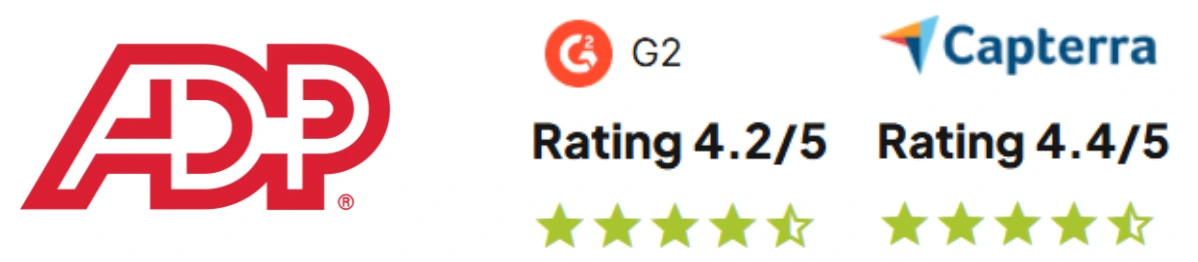
G2: 4.1/5 | Capterra: 4.4/5 | Software Advice: 4.4/5 (based on 7,000+ reviews, February 2026)
Positive: "Saves so much time in doing the prep work for filings," HR Manager Critical: "ADP does not value your time," Payroll Specialist
ADP's review volume is massive, reflecting its size. Satisfaction patterns favor ADP for compliance depth and analytics; critical reviews cluster around support responsiveness and per-payroll fees.

Paylocity Reviews
G2: 4.4/5 | Capterra: 4.3/5 | TrustRadius: 8.1/10, Buyer's Choice 2025 (based on 2,800+ reviews, February 2026)
Positive: "Paylocity has been a breath of fresh air for my small business," Business Owner Critical: "Annual standard price increases every year," HR Director
Volume of reviews favors ADP by a wide margin; satisfaction and quality-of-support scores favor Paylocity on G2. Paylocity has held G2 Leader status for 28 consecutive quarters.
Ratings and quotes from G2, Capterra, TrustRadius as of February 2026. Quotes shortened for clarity.
Should You Consider Sunrise HCM Over ADP and Paylocity?
The ADP vs Paylocity comparison covers two legitimate platforms for payroll and HR. Neither is built natively on Salesforce, and neither connects payroll to project billing in a single system. If you're looking for a Salesforce payroll software that handles that connection natively, Sunrise HCM is built specifically for U.S.-based employers who need payroll, HR, time, and billing in one place. Here's where it takes a different approach.
Built on Salesforce, No Salesforce Required
Sunrise HCM runs on Salesforce. You don't need an existing Salesforce instance or a separate license. The platform infrastructure is included in your subscription. Your data lives in one proven database used by banks, hospitals, and government agencies for 20+ years. Already using Salesforce? Your pricing will be lower. The platform license is included in each user price, and we discount based on licenses you already hold.
Enterprise Security by Design
SOC 2 Type II compliance comes standard. Encryption in transit and at rest, role-based access control, multi-factor authentication, and continuous monitoring are all included. You don't manage the infrastructure; it runs on a platform trusted by Fortune 500 companies globally.
Real-Time Data Integration
Time entry flows once to both payroll and project billing. HR changes update downstream immediately. There are no export files, no overnight syncs, and no manual reconciliation between systems. The platform connects to other business systems through industry-standard open APIs that developers already know.
True Scalability
Three platform releases per year happen while you work. No upgrade fees. No downtime. No compatibility issues. Everyone's always on the current version.
U.S.-Based Support Included
Every client gets an assigned U.S.-based relationship manager and a designated backup at no extra cost. There are no premium support tiers to buy and no offshore call centers.
Transparent Pricing
- $16 per employee per month
- $48 per functional manager per month
- $58 per HR Manager per month
- $58 base fee per month
Everything included: payroll processing, tax filing, W-2s, HR Management, time tracking, expense management, and billing. No per-payroll fees. No transaction fees. No surprise charges. Discounted pricing for nonprofits, government organizations, and educational institutions. Sunrise HCM is the only end-to-end Salesforce HR Software.
When Sunrise HCM makes sense:
- You need payroll and project billing connected in one system
- You want enterprise security without managing infrastructure
- You value transparent, predictable pricing
- You're already on Salesforce, or open to building on it
When to stick with ADP or Paylocity:
- You need global payroll across multiple countries (Sunrise is U.S. only)
- You want employee-verified payroll through a BETI-style system (consider Paycom instead)
- You only need payroll and basic HR without project billing
Implementation takes 8–12 weeks, including full configuration, training, and parallel payroll runs.
Contact us to see how payroll, HR, time, and billing work together in one system.
Frequently Asked Questions
Who is ADP's biggest competitor?
Paylocity is ADP's most direct mid-market competitor for U.S.-focused businesses with 50–1,000 employees. At the enterprise level, Workday and UKG compete more closely. Most mid-market buyers evaluate these two together before deciding in the ADP vs Paylocity space.
What are the pros and cons of using ADP?
ADP's strengths are global reach, compliance depth, and the option to outsource HR functions entirely. Its drawbacks include non-transparent pricing, per-payroll fees, and support that can be slow to resolve issues at scale.
Why are companies moving away from ADP?
Most companies leave ADP for simpler pricing, better user experience, or more responsive support. Mid-market buyers often switch to Paylocity for its cleaner interface and lower costs. Companies needing payroll connected to billing often look at options like Sunrise HCM.
How does Paylocity compare to ADP?
In this ADP compared to Paylocity review, Paylocity wins on user experience, engagement tools, integration breadth, and mid-market pricing. ADP wins on global payroll, compliance management, and the ability to outsource HR administration entirely. For most mid-market buyers doing a paylocity vs adp comparison, those two factors - UX and pricing - are usually the deciding ones.
What's the difference between Paylocity, ADP, and Sunrise?
The core ADP compared to Paylocity difference is scale and philosophy. ADP targets enterprises needing global capabilities; Paylocity focuses on mid-market employee experience. Sunrise HCM runs on Salesforce and connects payroll to project billing, which neither ADP nor Paylocity does.
Does one of these platforms offer superior compliance support?
ADP has the edge on compliance management, especially for multi-state nexus, multi-country requirements, and complex tax jurisdictions. Its compliance database draws on decades of payroll processing data across 1 million+ clients.
Which platform protects data best?
All three platforms meet standard security requirements. Sunrise HCM runs on Salesforce, which carries SOC 2 Type II certification. That means encryption in transit and at rest, continuous monitoring, and infrastructure trusted by banks and government agencies. ADP and Paylocity both maintain strong security postures appropriate to their scale.
Do Paylocity and ADP support API integrations?
Both platforms support API integrations. Paylocity offers nearly 400 out-of-box marketplace connections plus an open API. ADP expanded its API access recently and connects to 300+ tools. For custom real-time data flows, open APIs matter more than marketplace connectors in both cases.
Are ADP and Paylocity considered end-to-end systems?
Both cover payroll, HR, benefits administration, time tracking, and talent management. Neither connects to project-based billing or expense management in a single system. If billing is central to your Paylocity vs ADP comparison, you'll need a different tool. Sunrise HCM is one option worth looking at.
Which payroll and HR provider is the best for my company?
Every Paylocity vs ADP comparison comes down to size, footprint, and what the platform connects to. Use this ADP vs Paylocity breakdown as a starting point, then request demos from both vendors before deciding.
Does Sunrise HCM offer discounts for nonprofits or government organizations?
Yes. Sunrise HCM offers discounted pricing for nonprofits, government organizations, and educational institutions. Contact us to discuss pricing specific to your organization type.
What kind of customer support does Sunrise HCM provide?
Every Sunrise HCM client gets a dedicated U.S.-based relationship manager and a designated backup. There are no extra fees for premium support tiers and no offshore call centers. You always know who to contact when you need help.



Ready to eliminate payroll fees, and simplify HR processes?
Discover how Sunrise HCM helps you automate payroll, HR, and billing with one secure and powerful Salesforce-native platform.
Keep Reading